
Memorials: Collective memory, distributed cognition and urban environment
Lucas M. Bietti
Norwegian University of Science and Technology
Contacto: lucas.bietti@ntnu.no
Orcid: https://orcid.org/0000-0002-4380-2615
Abstract:
This article investigates how memorials shape collective memory, highlighting the interplay between biological, sociocultural, and technological factors. Memorials are intentionally created to generate meaning of the past according to the present interests and motivations. Individuals, groups, networks and institutions design and build memorials to not just shape perceptions of history but also steer collective perspectives on a shared future. We argue that memorials are external memory system, both limiting and shaping the recollection of the event being commemorated. Thus, the collective memories of the visitors to memorials are the outcome of outcome distributed cognitive networks, where human minds interact with external memory systems. We showcase how two cities, Buenos Aires and Berlin, have transformed into hubs of collective remembrance. Following this, we introduce cognitive ethnography as a methodology to explore how collective remembering emerges from visitors’ interactions with memorials.
Keywords: Memorials, Collective memory, Urban environment, Buenos Aires, Berlin.
Resumen:
Este artículo investiga cómo los monumentos dan forma a la memoria colectiva, destacando la interacción entre factores biológicos, socioculturales y tecnológicos. Los monumentos conmemorativos se crean intencionalmente para generar significado del pasado de acuerdo con los intereses y motivaciones presentes. Individuos, grupos, redes e instituciones diseñan y construyen monumentos conmemorativos no sólo para dar forma a las percepciones de la historia, sino también para orientar las perspectivas colectivas sobre un futuro compartido. Sostenemos que los memoriales son sistemas de memoria externos, que limitan y configuran el recuerdo del evento que se conmemora. Por lo tanto, los recuerdos colectivos de los visitantes de los monumentos conmemorativos son el resultado de redes cognitivas distribuidas, en el que las mentes humanas interactúan con sistemas de memorias externas. Abordamos cómo dos ciudades, Buenos Aires y Berlín, se han transformado en centros de memoria colectiva. El presente artículo emplea la etnografía cognitiva como metodología para explorar cómo el recuerdo colectivo emerge de las interacciones de los visitantes con los monumentos conmemorativos.
Palabras clave: Monumentos, memoria colectiva, ambiente urbano, Buenos Aires, Berlín.
Introduction:
Collective memory has been defined as individual memories that are shared across members of a community (Hirst&Manier,2008). Collective memory plays a key role in human life, affecting our personal and historical memories, and forging our cultural identities. Collective memory can be operationalized as individual memories shared across a community that bear on the community’s identity (Coman et al., 2009). Collective memory belongs to an identity project that members of groups often use to preserve an established group history and maintain group cohesion (Wertsch, 2002).
Collective memory is therefore crucial, especially in a time of global uncertainty (e.g.,climate change, migrations, COVID-19 pandemic), when new challenges require confronting and sometimes overcoming previous collective memories to imagine and plan new collective futures (Bietti & Mayor, 2022). Fake news, for instance, are known to quickly spread across people, creating narratives that distort collective memories and massively affect political and economic decisions.
Wertsch (2009) maintains that collective memories are composed of representations of the past distributed among people and cultural tools. The interaction between these elements within specific cultural, historical and technological environments creates the conditions for the emergence of collective memories. That is, the formation and transmission of collective memories is constrained by biological, sociocultural and technological resources as well as by cultural practices. The social, cultural and technological resources depend on cultural differentiations. One culture may supply mnemotechnic practices that distinguish it from others (Wang, 2013).
Collective memories are supported by distributed cognitive networks. Distributed cognitive networks (Donald, 2007) integrate embodied human minds into larger institutional structures with their own histories and dynamics. In this way, external memory systems together with internal memory systems create the conditions for the emergence of distributed cognitive networks formed by interwoven neural capacities and external memory devices. An example of such adaptations can be observed in new research on the Internet and its effects on memory, which suggests that human memory is adapting to new computing and communication technology (Sparrow, Liu & Wegner, 2011). These new adaptations are reflected in the claim that we “remember less by knowing information than by knowing where the information can be found” (Sparrow et al. 2011, p.778).
For quite some time people have relied on external systems to remember. External systems include painted and sculpted images, measuring instruments, written records (books), mathematical notations, libraries and archives (Donald, 1991). The built environment (i.e., the settings for human activity) is another central external system supporting memory. Concerning collective memory, memorials play a pivotal role within the spatial environment, serving to both limit and mold the recollection of the event being commemorated (Brown & Reavey, 2020; Wagoner & Brescó de Luna, 2022). They are cultural artefacts intentionally created to generate meaning of the past according to the present interests. Memorials are tangible records of human endeavor which serve to remind locals and visitors of an event, and when associated to collective memory they are often about events or situations related to political events, periods of political violence and terrorist attacks.
The aim of this article is to investigate the role that memorials play in shaping collective memories, considered as the outcome of distributed cognitive networks. These synchronize individual and collective memories and knowledge held by both locals and visitors about the events being commemorated, the body of visitors in their situated and distributed interactions with the memorials and the memorials themselves, with their spatial arrangements and characteristics. The article also introduces a methodological approach (i.e., cognitive ethnography) to empirically investigate the embodied and distributed interactions that visitors have with memorials. In the next section we discuss the role that memorials play as external symbolic devices scaffolding human memory. Then, we present the example of two cities (Buenos Aires and Berlin) that have become zones of collective remembrance. Subsequently, we introduce cognitive ethnography as methodology to examine the ways in which collective remembering emerges as the result of visitors’ embodied, situated interactions with the memorials.
Memorials as exograms
Donald (2010) uses the distinction between “engrams” (Ogden & Richards, 1956) and “exograms” (Donald, 1991) to explain how the storage capacity of biological memory systems became enhanced throughout human cultural evolution. Engrams are mental impressions caused by memory traces in the human mind, which are the residual trace of an adaptation made by the organism in response to a stimulus (Ogden & Richards, 1956). Exograms are defined as external symbolic devices linked to the present context ofrememberingthatallow ustoextend and enhanceourbio-memorysystems.Donald arguesthatexograms enable human beings to manipulate complex representations by significantly augmenting the capacity of working memory. In this way, non-biological memory storage (e.g., photographs) together with the biomemory systems create the conditions for the emergence of distributed cognitive networks formed by the interwoven neural capacities and external memory devices (Sutton et al., 2010).
Memorials enhance remembering a shared past. They are tangible records of human endeavor which serve to remind us of a past event or historical period. They are intentionally created to generate meaning of the past according to the present interests and motivations. Individuals, groups, networks and institutions design and build memorials to not just mold perceptions of history but also steer collective perspectives on a shared future. Memory is one of the main building blocks of identity. Collective Identity is constructed on what and how individuals, groups, networks remember (Assmann & Czaplicka, 1995; Heersmink, 2023). Memorials related to terrorist attacks, political events and periods of political violence are used to forge, transmit and consolidate collective memories (Brescó de Luna & Wagoner, 2022). They are usually the result of disputes, conflict and struggles and are central for the formation of collective identities. Memorials about terrorist attacks, political events and periods of political violence separate commemorative spaces from society, facilitating remembrance and standing as cultural artifacts crafted to encapsulate collective memory. They are part of the urban geography, transforming the urban landscape with which people interact with. Individuals situated, embodied and distributed interactions with memorials about political events, periods of political violence and terrorist attacks endow them with cognitive life, bringing a shared past into the present and shaping collective identities.
Methodology
Cognitive ethnography and collective remembering
Although instances of collective remembering may occur over a very short time-scale in the present (e.g. a ten seconds interaction with a plaque in the sidewalk), they would still connect multiple time-scales, some of them referring to a distant past (Bietti & Sutton, 2015). The question that comes next is how such multi-layered interactions unfolding over several time-scales can be empirically examined in the wild, that is in the environments in which they occur.
Cognitive ethnography has become an established research method in the social sciences (Williams, 2006), cognitive sciences (Hutchins, 1995, Bietti & Baker, 2018; Bietti et al., 2016), health sciences (Hazlehurst et. al., 2008) and Human-Computer Interaction (Ball & Ormerod, 2000). Ethnography focuses on the study of cultures, social interactions, and behaviors in groups, teams, organizations, and communities in their own environments (Howitt, 2010). To do so, researchers collect detailed field notes and observations, conduct and analyze interviews with members of the groups they study, perform artifact analyses, examine relevant written documents and may use social network analysis tools to map and visualize social relationships among group members. Digital technologies have significantly changed the way in which ethnography is conducted, giving the possibility to collect large amounts of audio and video data in an affordable and efficient fashion.
Cognitive ethnography is based on the use ethnographic methods but puts significant more emphasis on documenting with a high level of granularity how human cultural and cognitive activities unfold in context and how these are distributed over space and time (Dubbels, 2011; Williams, 2006).
While an ethnographic study on collective memory and memorials about the Nazi history and the Second World War would be based on audio or video-recorded interviews with visitors of, for example, The Memorial of the Murdered Jews of Europe in Berlin following interview-guidelines to obtain information about the phenomenon under investigation, a cognitive ethnographic study of the same phenomenon will be based on audio and video recordings of the actual interactions that visitors, with the memorial, followed by interviews where visitors would be asked to elaborate on their own behaviors and thoughts while navigating the Memorial of the Murdered Jews of Europe. The research focus of cognitive ethnography is on the study of situated, embodied and distributed cognitive activities embedded in social and material environment and evolving at multiple time-scales. From a cognitive ethnographic perspective, the study of the ways in which people remember needs to build from units of analysis that cut across the distinction between inside and outside, subject and object, knower and tool (Brown & Reavey, 2020). The unit of analysis in cognitive ethnography is the cognitive and cultural eco-system rather than the individuals in isolation (Hutchins, 1995, 2014).
The use mobile technologies are one way in which researchers can investigate how visitors interact with memorials. Brescó de Luna and colleagues examined visitors’ experiences using the subjective camera (Sub-cam) at several memorials around the world, including the Memorial to the Murdered Jews of Europe in Berlin, the National 9/11 Memorial in New York City, The Valley of the Fallen in e Sierra de Guadarrama near Madrid, and Hiroshima Peace Memorial Park in Hiroshima (Brescó de Luna & Wagoner, 2022; Brescó de Luna, Li & Wagoner, 2022; Wagoner & Brescó de Luna, 2022). The Sub-cam consists of miniature videocamera worn at the eye-level (Glaveanu & Lahlou, 2012; Lahlou, 2011), capturing firsthand audio-visual recordings of human activities from a first-person, subjective perspective. Brescó de Luna et al. complemented first person audio-visual recordings of the visitors of memorials with confrontational interview based on the recording to delve into the participant’s subjective experience, and researchers’ interpretations and discussions about them with the visitors. They found how memorials provided significant contexts where visitors weaved together various aspects of their identity—memories, relationships, emotions, thoughts—into the tangible and sensory aspects while exploring these environments. The authors observed that visitors’ embodied and distributed interaction with memories were not only shaped by the physical layout or intended meaning. Instead, visitors interpreted and engaged with the memorials in various ways, influenced by personal memories and associations during while exploring the site (Brescó de Luna, & Wagoner, 2022). These findings indicate that the material and spatial environment is not constrained by the specific setting in which acts of remembering take place (Brown & Reavey, 2020). Material and spatial environments constitute a larger life space (Lewin, 1936) in which all of the active relational forces shaping acts of remembering may be present, though these forces will depend on the particular setting in which this remembering occurs (e.g. Memory Park). They can also be “spatially and temporally remote” (Brown & Reavey, 2020, p. xx) but still shape the reconstruction of individual and collective memories.
Brescó de Luna et al. (2022) are the only studies, that to our knowledge, have investigated the multiple ways in which visitors interact with memorials, from an embodied and distributed perspective. They took into account the inter-animation of individual and collective memories of the events and periods being commemorated, the individual and socially shared knowledge about them, the emotions associated to those events and periods, and the material resources that were used to produce them along with their spatial arrangements.
Two cases: Berlin and Buenos Aires
Cities hold a central role in determining locations of memory, serving as privileged sites that encapsulate and preserve collective remembrances. Certain cities offer interactive online maps allowing users to virtually explore the urban landscape, highlighting sites of collective remembrance typically linked to moments of political upheaval and violence. Berlin, with its Prussian and Nazi history, coupled with its post-World War II division and the Berlin Wall, exemplifies a city where deliberate institutional endeavors aimed to transform the urban space into an expansive collective memory canvas. The city’s official marketing agency (see: www.visitberlin.de), provides Berliners and tourists the chance to virtually explore city neighborhoods. They use red dots as markers highlighting memorial locations, varying from grand, controversial structures like the Memorial of the Murdered Jews of Europe (Figure 1), altering the cityscape significantly, to smaller, unassuming tributes like the White Crosses Memorials (Figure 2), often overlooked by visitors due to their modest nature.
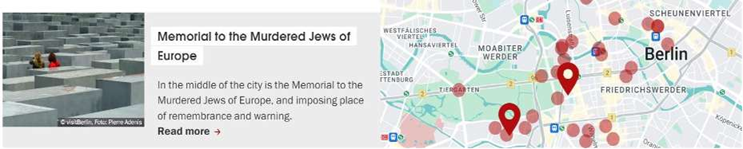
Figure 1.The Memorial of the Murdered Jews of Europe consists of 2,711concrete slabs of different heights set on uneven terrain. It stands adjacent to significant landmarks like the Brandenburg Gate, the Reichstag (Parliament),and the path once traced by the Berlin Wall. Its abstract design has stirred controversy, drawing criticism for its absence of personalized representation of Holocaust victims and educational context.
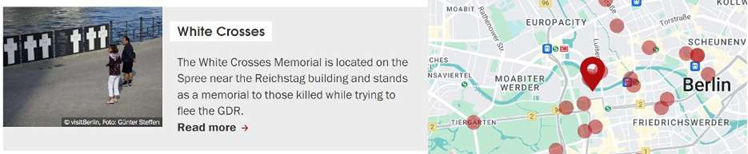
Figure 2. The White Crosses Memorial consists of simple white crosses on a lawn near the Reichstag, each representing a person who died while attempting to cross the Berlin Wall during its existence. This memorial serves as a reminder of the human toll and sacrifices made during the division of Berlin.
This initiative is not confined solely to European cities commemorating the atrocities of the Second World War or other significant political events, periods marked by political violence, or terrorist attacks. Efforts, both institutional and non-institutional, have been dedicated to crafting and providing similar online interactive maps in Latin American cities too, giving the opportunity to both locals and visitors to explore sites of collective memory. The City of Buenos Aires created an interactive map of memorials named Traces of Memory (Huellas de la Memoria; Figure 3.) where locals and visitors to the city can explore diverse memorial sites. These include the Memory Park (Figure 4.), former covert detention and torture centers transformed into places of remembrance (Figure 5.), stand alongside squares, monuments, plaques, tiles, and other locations marking the disappearances of individuals within the city (Figure 6.).
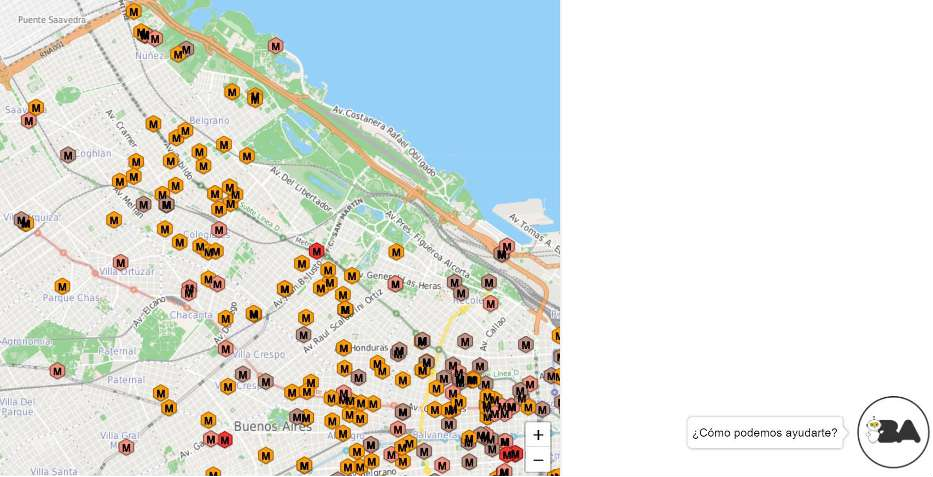
Figure 3. Dots indicate the location of memorials associated to human rights abuses committed during the 1976-1983 Military Dictatorship in Argentina (see:
https://buenosaires.gob.ar/vicejefatura/derechoshumanos/memoria-ba-mapa-interactivo-huellas-de-lamemoria).
Source: https://buenosaires.gob.ar/vicejefatura/derechoshumanos/memoria-ba-mapa-interactivo-huellasde-la- memoria
Thousands of people were abducted and murdered by the perpetrators of the military regime. Hundreds of babies were born in captivity because their mothers had been kidnapped and were killed soon after giving birth. Relatives of the victims uncovered evidence that some of these babies were being passed off as the adopted children of military officers. The narrative created by the military junta leaders was sustained by a discourse on war which mentioned the non-conventional methods that the enemy was using to destabilize the status quo. This is why the conflict was named the ‘Dirty War’, and this was how it became known abroad. The enemies identified by the military included not only people who carried out violent acts against the armed forces (e.g., members of guerrilla movements), but also ideological subversives, such as teachers, professors, students, factory workers, journalists and lawyers. A large proportion of the bodies of the victims of themilitary dictatorship were never found. Hence, the victims of the military regime came to be known as the desaparecidos.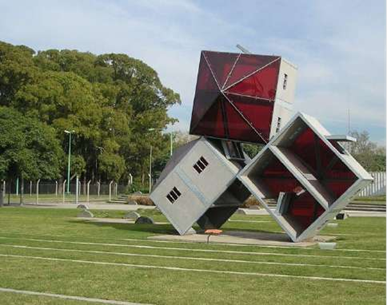
Figure 5. Monument to Scape (Monumento al escape), steel, laminated glass and various materials; Dennis Oppenheim, 6 x 7 x 2,80 mts, 1999-2001. The monument is located at the Memory Park that is a public space located along the Río de la Plata in the northern area of Buenos Aires aimed at commemorating the victims of state terrorism (see: https://parquedelamemoria.org.ar/en/monument-to-scape/).
Source: https://parquedelamemoria.org.ar/en/monument-to-scape/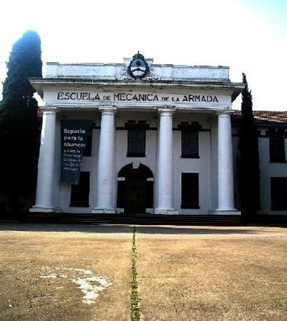
Figure 6. The School of Naval Mechanics (ESMA - Escuela de Mecánica de la Armada) was a notorious detention and torture center used by the Argentine military junta during the 1976-1983 dictatorship. It was a place where dissidents, activists, and suspected opponents of the regime were detained, tortured, and often killed. ESMA became a symbol of the human rights abuses committed during that dark period in Argentina’s history. After the return of democracy, efforts were made to preserve it as a memorial site to honor the victims and remember the atrocities that occurred there. (© Lucas Bietti 2008).
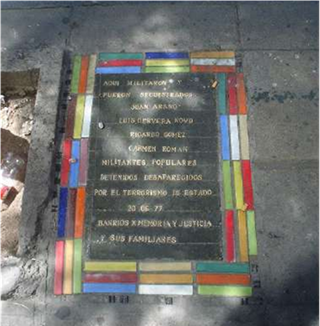
Figure 7. Figure 7. The sidewalk plaque commemorates the spot where Juan Arano, Luis Cervera Novo, Ricardo Gomez, and Carmen Roman, well-known activists and militants, were seized. They were later detained and disappeared by state terrorism on June 20, 1977. This plaque stands as a testament to their memory, created by Neighborhoods for Memory and Justice along with their relatives.
Source: Lucas Bietti 2008.
Berlin and Buenos Aires are just two examples of cities where institutions provide interactive online maps enabling locals and visitors to virtually navigate the cityscape, spotlighting locations steeped in collective memory often associated with periods of political turmoil and violence. Memorials became part of the urban geography, shaping memories of thousands of people who pass by those sites of remembrance. They transformed the urban landscape locals and visitor interact with. Thus, they may affect the manner people remember historical events they commemorate and bring into the present. The cityscape of Berlin and Buenos Aires are organized to facilitate processes of collective remembering events and periods related to political violence. Memorials of such kind behave as exograms, described as external symbolic tools connected to the current memory context, enabling locals and visitors to expand and enrich their biological memory systems. Hence, collective remembering can no longer be simply characterized purely at an abstract, brain-bound, information- processing level, but as interacting networks, which integrate and synchronize the brain (e.g., the locals and visitors individual memories and knowledge of the events being commemorated), the body (e.g., the ways in which they interact with the memorials), and the world (e.g., the memorials) in a functional and goal-oriented manner (e.g., Hutchins, 2014). Collective remembering in these particularly designed and crafted environments do not just occur in the brains of locals and visitors to the Berlin and Buenos Aires, but rather in cultural and cognitive eco-systems. These are formed by the interaction of individual and collective memories of the events and periods being commemorated (e.g., recalling the neighbor who was taken away by the military police because she was “mixed up with something”), the individual and socially shared knowledge about them, the emotions (e.g., fear, anger, sadness, pride, etc.) associated to those events and periods, and the material resources that were used to produce them along with their spatial arrangements. These span from monuments meticulously crafted by professional artists and situated in specialized designated zones of remembrance (Figure 1) to the more modest and spontaneous plaques found in city sidewalks (Figure 6).
Conclusion
Often remembering occurs in embodied, situated and distributed interactions embedded in material environments. It unfolds while interacting with various types of artefacts, from desktop computers and laptops and mobile phones to notes, diagrams and sketches drawn quickly and spontaneously in post-its, notebooks, etc. When these memories are about autobiographical events, situations and actions they may also rely in individual’s embodied, situated and distributed interactions with cultural artefacts, such as physical and digital photos, diaries, souvenirs, and objects of different kind (e.g., the ticket to the football match I attended with my eldest son in Paris in 2019). Autobiographical memories are essential for identity. Sometimes these cultural artefacts (e.g., ticket to the football match) are also essential for who we are (e.g., father).
Collective Identity hinges on how individuals, groups, networks, and institutions remember a shared past and envision a common future. Cultural artifacts playa pivotal role in shaping collective memory, with memorials standing as significant cultural artifacts that mold, reinforce, and perpetuate collective memories. These structures are intentionally crafted to reinterpret the past in line with present interests and motives, particularly evident in collective memories tied to political events, periods of violence, or terrorist acts. Individuals and institutions purposefully construct memorials not only to influence historical perceptions but also to direct collective visions of the future. In this article we argued that memorials function as exograms, serving as external memory systems that both confine and sculpt the remembrance of the commemorated event. Thus, visitors’ collective memories formed at memorials stem from distributed cognitive networks, where human minds engage with external memory systems. We presented the example of two cities (Buenos Aires and Berlin) that have become zones of collective memory and outlined how cognitive ethnography serves as a method to investigate the emergence of collective remembering through visitors’ engagements with memorials. Future studies on how memorials shape collective memory must take into consideration the ways in which visitors’ embodied, situated and distributed interactions with such cultural artefact affect the construction, consolidation, transmission and propagation of collective memories in over time.
References
Assmann, J., & Czaplicka, J. (1995). Collective memory and cultural identity. New German Critique, 65, 125-133.
Ball, L. J., & Ormerod, T. C. (2000). Putting ethnography to work: the case for a cognitive ethnography of design. International Journal of Human-Computer Studies, 53(1), 147-168.
Bietti, L. M., & Mayor, E. (2023). A longitudinal study of conversational remembering in WhatsApp group messages before, during, and after COVID-19 lockdown. Memory, Mind & Media, 2, e5. doi:10.1017/mem.2023.5
Bietti, L.M. & Baker, M.J. (2018). Collaborative remembering at work. Interaction Studies, 19 (3), 459- 486.
Bietti, L.M., Baker, M. J., & Détienne, F. (2016). Joint remembering in collaborative design: A multimodal approach in the case of a video design studio. CoDesign: International Journal on CoCreation in Design and the Arts, 12 (4), 221-242.
BiettiL.M.&Sutton,J.(2015).Interactingtorememberatmultipletimescales:Coordination,collaboration, cooperation and culture. Interaction Studies, 16 (3),419-450.
Brescó de Luna, I and Wagoner, B (2022) Memorials from the perspective of experience: A comparison of Spain’s Valley of the Fallen to contemporary counter-memorials. Memory Studies. doi:10.1177/17506980221126943CrossRefGoogle Scholar.
Brown, S. D., & Reavey, P. (2020). Memory in the wild: Life space, setting-specificity, and ecologies of experience. In B. Wagoner, I. Brescó de Luna, & S. Zadeh (Eds.), Memory in the wild (pp. 3–56). Information Age Publishing, Inc.
Coman, A., Brown, A.D., Koppel, J., & Hirst, W. (2009). Collective memory from a psychological perspective. International Journal of Politics, Culture and Society, 22(2), 125–141.
Donald, M. (2010). The exographic revolution: Neuropsychological sequelae. In Malafouris L. & Renfrew C. (Eds.), The Cognitive Life of Things: Recasting the boundaries of the mind (pp. 71-79). Cambridge, UK: McDonald Institute Monographs.
Donald, M. (2007). The slow process: A hypothetical cognitive adaptation for distributed cognitive networks. Journal of Physiology (Paris), 101, 214–222
Donald, M. (1991). Origins of the modern mind: Three stages in the evolution of culture and cognition. Cambridge, MA: Harvard University Press.
Dubbels, B. (2011). Cognitive ethnography: A methodology for measure and analysis of learning for game studies. International Journal of Gaming and Computer-Mediated Simulations (IJGCMS), 3(1), 68–78.
Glaveanu, V. P., & Lahlou, S. (2012). Through the creator’s eyes: Using the subjective camera to study craft creativity. Creativity Research Journal, 24(2-3), 152-162.
Hazlehurst, B., Gorman, P. N. & McMullen, C. K. (2008). Distributed cognition: An alternative model of cognition for medical informatics. International Journal of Medical Informatics, 77, 226-234.
Heersmink, R. (2023). Materialised Identities: Cultural identity, collective memory, and artifacts. Review of Philosophy and Psychology, 14 (1), 249-265.
Hirst, W., Yamashiro, J.K. & Coman, A. (2018). Collective memory from a psychological perspective. Trends in Cognitive Sciences 22, 438–451.
Hirst, W., & Manier, D. (2008). Towards a psychology of collective memory. Memory, 16(3), 183–200 Hutchins, E. (2014). The cultural ecosystem of human cognition. Philosophical Psychology, 27(1), 34– 49 Hutchins, E. (1995). How a cockpit remembers its speeds. Cognitive Science 19, 265–288.
Lahlou, S. (2011). How can we capture the subject’s perspective? An evidence-based approach for the social scientist. Social Science Information, 50 (4), 607-655.
Lewin, K. (1936). Principles of topological psychology. (F. Heider & G. M. Heider, Trans.). McGraw-Hill. Ogden, C. K. & Richards, I. A. (1956). The meaning of meaning: A study of the influence of language upon thought and of the science of symbolism. New York: Harcourt, Brace.
Sparrow, B, Liu, J. & Wegner, D.M. (2011). Google effects on memory: Cognitive consequences of having information at our fingertips. Science 333, 776–778.
Sutton, J., Harris, C.B., Keil, P.G., & Barnier, A.J. (2010). The psychology of memory, extended cognition, and socially distributed remembering. Phenomenology and the Cognitive Sciences, 9, 521– 560.
Wagoner, B. & Brescó de Luna, I. (2022). Memorials as healing places: A matrix for bridging material design and visitor experience. International Journal of Environmental Research and Public Health, 19(11), 6711.
https,,doi.org/10.3390/ijerph19116711.
Wang, Q. (2013). The autobiographical self in time and culture. New York: Oxford University Press.
doi:10.1093/acprof:oso/9780199737833.001.0001
Wertsch, J.V. (2002). Voices of collective remembering. Cambridge: Cambridge University Press. doi:10.1017/CBO9780511613715.
Wertsch, J.V. (2009). Collective memory. In P. Boyer & J.V. Wertsch (Eds.), Memory in mind and culture (pp. 117–137). Cambridge: Cambridge University Press.
Williams R. F. (2006). Using cognitive ethnography to study instruction. Proceedings of the 7th International Conference of the Learning sciences, Bloomington, Indiana: pp. 838 – 844.